
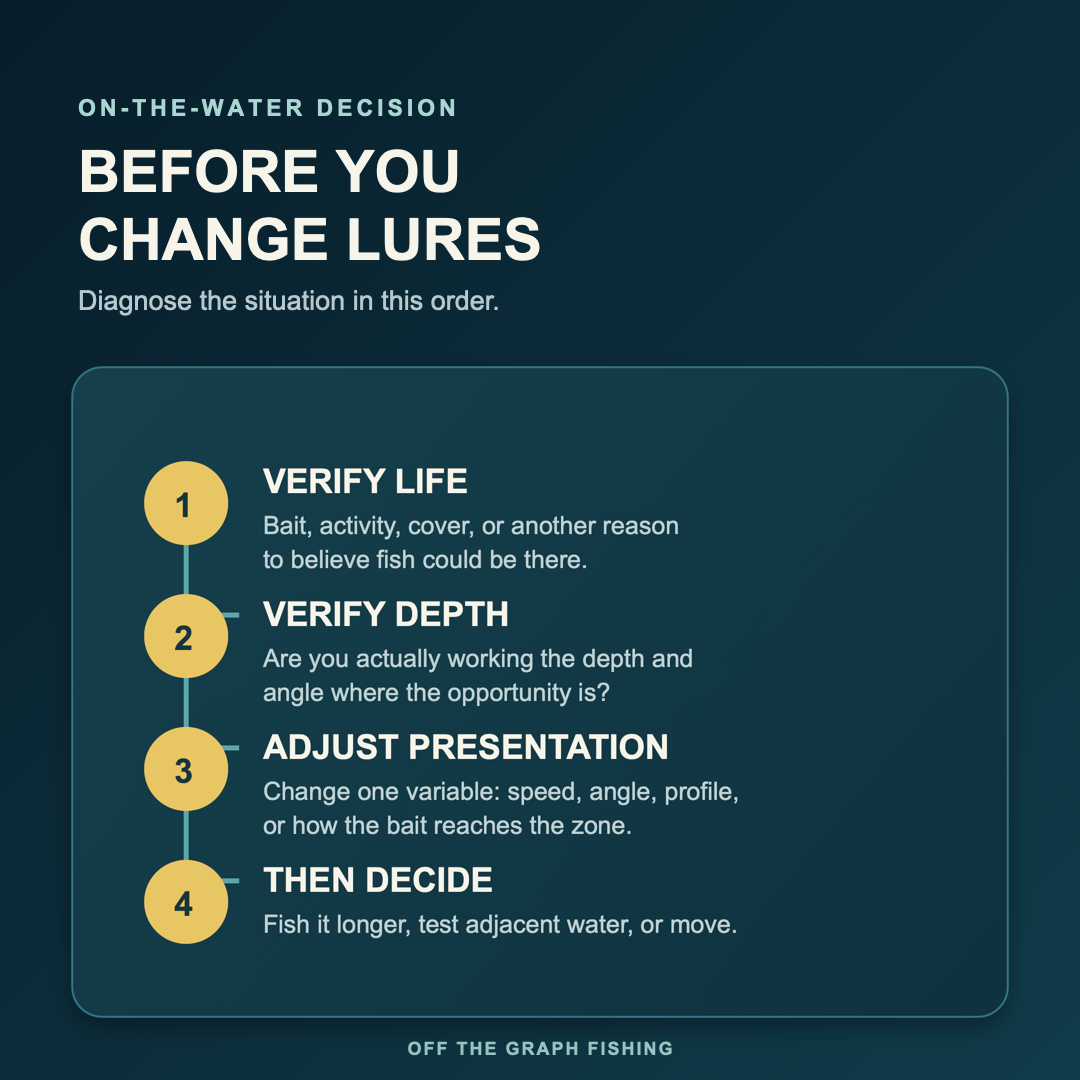
The first question after a quiet test is not “Which lure should I throw?” The first question is “What did this test actually rule down?” A useful adjustment preserves the information you earned instead of starting an unrelated test.
Change the variable for which your evidence is weakest. If direct response supports the place but not the presentation, keep the place and change one presentation variable. If a fair test produces no direct response, lower the priority of that exact place-and-presentation combination and move to the next planned test.
Diagnose the first test before changing anything
Write the completed test in one sentence. It should name four boundaries:
- The place or target you sampled
- The cast or boat path you repeated
- The lure and retrieve you used
- The cast count or time limit you completed
If one of those is missing, you may not have a comparable result yet. Finish or redefine the test before drawing a larger conclusion.
When to change location
Change location when the planned test is complete, you recorded no direct response, and you have another ranked area that tests a meaningfully different idea. The quiet result lowers the priority of the completed test. It does not prove there are no fish nearby, and it should not be generalized beyond the boundary you actually sampled.
“I completed 12 comparable casts along the named outside edge with no bite, follow, miss, or visible fish. I will move to my second planned area instead of changing three presentation variables in the same place.”
When to change the retrieve
A retrieve change is useful when your evidence gives the place enough support for one more comparison and speed or cadence is the specific unresolved question. Keep the target, cast path, and lure steady. Change only the retrieve variable you named.
A follow, miss, or repeated contact can justify a controlled retest inside this instructional model. It does not tell you why the response occurred. The retest is designed to gather another observation, not confirm a story.
When to change the lure
Change the lure when the place has earned another test and the lure characteristic is the variable you intend to compare. Name the characteristic before the retest, such as profile, action, or another visible presentation difference. Keep the place and path stable so the comparison remains interpretable.
“Try something different” is too broad. A controlled lure change should answer a defined question. If the next lure changes depth, speed, profile, and path at once, you have started a new test rather than refined the first one.
A practical order for the next decision
Verify the test boundary
Confirm that you completed the intended place, path, presentation, and limit.
Record the direct response
Write the bite, follow, miss, visible fish, or completed quiet test before adding an explanation.
Mark what the evidence supports
Keep those parts stable for the next comparison. Do not treat a single response as a complete pattern.
Choose one unresolved variable
Select location, path, retrieve, or lure characteristic. Change only that part.
Set the end of the retest
Give the retest its own cast or time limit, then stay, adjust, or leave based on the new evidence.
The common error: changing several things at once
Imagine that you move to a new target, choose another lure, change retrieve speed, and alter the cast angle. If the next cast produces a bite, four variables changed. You have a useful observation, but a weak comparison. If the goal is to learn from the adjustment, change the smallest part that can answer the next question.
“This retest produced a second response” is an observation. “Bass want this lure everywhere today” is a broader interpretation that the retest did not establish.
Choose the next controlled test
If you need the full setup before making an adjustment, start with how to build a bass fishing plan. If your problem is deciding when the first test has lasted long enough, use the guide to setting a move-on rule.